Tuesday, January 23, 2024

22 Healthy Easter Recipes That Are Easy to Make 2024 - The Pioneer Woman

This punchy dip gets its flavor from pickle juice and an assortment of dried dill, parsley, minced dried onions, and garlic. Serve it up with spring veggies, like radishes, carrots, and cucumbers, to snack on while the kids search for Easter eggs.

Get the Dill Dip recipe.

Adblock test (Why?)


from "recipes" - Google News https://ift.tt/LblMNsa
via IFTTT

José Pizarro’s recipe for winter vegetable empanada - The Guardian

Meet one of Spain’s oldest dishes: the classic empanada, which translates as “to wrap/coat in bread”. It’s a tasty, warming pie, not dissimilar to the British Cornish pasty, but lighter and with Spanish flavours. It originated in Galicia, our beloved Celtic region in the north of the peninsula, and it dates all the way back to medieval Iberia. Everyone loves these when I put them on the menu, they’re easy to make and incredibly versatile, because they can be filled with a variety of ingredients, both savoury or sweet. Traditionally, though, they are vegetarian or cheese-based, because that made them inexpensive for their original agricultural consumers.

Winter vegetable empanada with spicy relish

Prep 20 min
Rest 1 hr 30 min
Cook 1 hr 15 min
Cool 10 min
Makes 8

For the pastry
500g plain flour
1 tsp fine sea salt
200g unsalted butter
1
egg
2 tsp white vinegar
(white-wine or distilled malt)

For the relish
2 tbsp olive oil
1 red onion
, peeled and finely sliced
½ tsp each smoked hot and smoked sweet paprika
1 x 400g tin cherry tomatoes
75g soft light brown sugar
75ml apple cider vinegar
Sea salt and black pepper

For the filling
2 tbsp olive oil
1 onion
, peeled and finely chopped
85g cured chorizo, finely chopped
2 garlic cloves, peeled and finely sliced
1 tsp cumin seeds
½ tsp sweet smoked pimentón de la vera

½ tsp dried oregano
130g potatoes
, peeled and cut into ½cm dice
200g parsnips, peeled, cored and cut into ½cm dice
200g pumpkin or butternut squash, peeled and cut into ½cm dice
2 tsp sherry vinegar
1 big handful flat-leaf parsley
, picked and chopped
100g manchego, cut into small pieces
1 egg, beaten

First, make the pastry. In a large bowl, rub the flour, salt and butter with your fingertips until the mix resembles breadcrumbs. Blend the egg and vinegar with 75ml cold water, then tip into the bowl of dry ingredients. Mix quickly with a flat-bladed knife, until a dough starts to form, then bring it together with your hands.

Tip the dough on to a lightly floured surface, knead briefly, then shape into a ball. Flatten into a disc, wrap in clingfilm and chill in the fridge for at least 30 minutes.

Meanwhile, make the relish. Heat the oil in a frying pan, then gently saute the red onion, stirring, for five minutes, until softened. Add the spices, cook for a minute more, then add the tomatoes, sugar and vinegar. Season well, then simmer gently for 15 to 20 minutes, until it cooks down into a thick, glossy relish. Take off the heat and leave to cool.

Now for the filling. Heat the oil in a frying pan, then gently fry the onion, stirring, for five minutes, to soften. Add the chorizo, garlic, spices and oregano, and fry, stirring, for a further five minutes, until the chorizo releases its oil. Add all the diced vegetables and sherry vinegar, season generously, then cook on a low heat for three to four minutes, just to soften. Tip into a bowl, leave to cool, then stir through the parsley and manchego.

Divide the pastry into eight equal portions, then roll out each one into a thin disc about 15cm in diameter. Trim the edges, to neaten, if you prefer a smooth finish, then spoon an eighth of the filling into the centre of each pastry circle. Brush all around the edge with beaten egg, fold the pastry over the filling, to cover, then crimp the edges with your fingers or the tines of a fork, to seal.

Heat the oven to 200C (180C fan)/390F/gas 6, and line two baking sheets with greaseproof paper. Put four empanadas on each tray, brush all over with the beaten egg, then bake for 30 minutes, until golden brown. Remove, leave to cool for 10 minutes and serve warm with the relish, or leave to cool to room temperature and serve later.

Adblock test (Why?)


from "recipes" - Google News https://ift.tt/1J7aR0k
via IFTTT

Monday, January 22, 2024

Reese Witherspoon Defends Her Choice to Eat Snow After TikTok Debate - PEOPLE

Reese Witherspoon is not apologizing for her wintry dessert creation that sent the internet abuzz.

The actress, 47, posted a TikTok on Friday sharing her recipe for a snow-inspired creation she called a "snow salt Chococcino." After posting the video, the Your Place or Mine star received a wave of questions about whether or not freshly fallen snow was okay to eat.

In the original video, she showed someone scooping snow off a vehicle into coffee mugs, and then they added chocolate and caramel syrup on top of the snow. They topped off the dessert with some cold brew for a “yummy coffee flavor."

Reese Witherspoon scoops snow.

Reese Witherspoon/TikTok

After receiving questions as to whether she should be eating snow, she posted three videos defending her choice of snack as she hit back against the claim that “snow is dirty.”

“We went and took snow from the backyard and we microwaved it and it’s clear. Is this bad?” she asked with a laugh as she responded to a comment that asked her to “put snow in a clear cup and let it melt” to see if it’s “safe to eat.” 

“Am I not supposed to eat snow?” she asked.

She then decided she’s “in the category of ‘you only live once,’ and it snows maybe once a year here,” in another video, before adding that the snack was “delicious.”

In her third and final video on the subject, Witherspoon said that she’d grown up not drinking filtered water — “we actually put our mouths on the tap,” she admitted — as one commenter told her she could “get seriously sick” from eating snow. 

“So what you’re saying to me is I have to filter the snow before I eat it? I just can’t. I can’t filter snow, I don’t know how to do that," she said.

Never miss a story — sign up for PEOPLE's free daily newsletter to stay up-to-date on the best of what PEOPLE has to offer, from celebrity news to compelling human interest stories.

Though Witherspoon responded to some of the comments that expressed concern over her sweet snow creation, other people shared their own experiences of making snowy snacks.  

“We ALWAYS ate snow with sugar and vanilla when I was a kid!! ALWAYS,” one user commented, while another said, “I’ve been eating snow ice cream for 60+ years and I’m fine.”

Adblock test (Why?)


from "recipes" - Google News https://ift.tt/qOP48hy
via IFTTT

Sunday, January 21, 2024

30 High-Protein Meals — Easy High-Protein Recipes and Ideas - Good Housekeeping

Eggs get mentioned a lot when people talk protein, and for good reason: Eggs contain all nine essential amino acids (so yep, they're a complete protein!). Plus, a single egg has anywhere between five to eight grams of protein, depending on its size.

Get the Sweet Potato Breakfast Burritos recipe.

Adblock test (Why?)


from "recipes" - Google News https://ift.tt/8hT0mtO
via IFTTT

Coffee ground cookies recipe - The Telegraph

You can save spent coffee grounds until a cookie urge strikes: freeze them in a ziplock bag, then defrost before use.

Timings

Prep time: 15 minutes, plus 1 hour chilling

Cook time: 12 minutes

Makes

About 20

Ingredients

  • 180g plain flour
  • 40g skinned hazelnuts, toasted and roughly chopped
  • 50g cocoa powder
  • 60g spent coffee grounds
  • ½ tsp bicarbonate of soda
  • 100g softened butter
  • 80g soft light-brown sugar
  • 100g caster sugar
  • 1 large egg, lightly beaten

Method

  1. Put the flour, nuts, cocoa powder, coffee grounds, bicarbonate of soda and a good pinch of fine sea salt in a medium bowl, and stir well with a fork.
  2. Beat the butter and sugars together until pale and creamy. 
  3. Gradually beat in the egg. 
  4. Stir in the dry ingredients, mixing until you have a stiff dough. Chill for at least 1 hour.
  5. Preheat the oven to 180C/160C fan/gas mark 4 and line a baking sheet.
  6. Pull off pieces of dough and roll into balls the size of large walnuts.
  7. Arrange on the baking sheet about 7cm apart. If you need to bake in batches, keep unused dough in the fridge.
  8. Bake for 6 minutes, then turn the sheet around and bake for 6 more. 
  9. As soon as the cookies come out of the oven, press down gently on each one with the bottom of a glass, just enough to flatten the top slightly. This results in a desirably chewy cookie.
  10. Leave on the tray for a few minutes to firm up, then transfer to a wire rack to cool completely.

Recipe from Second Helpings by Sue Quinn (Quadrille, £18.99)

Adblock test (Why?)


from "recipes" - Google News https://ift.tt/5pjIMgu
via IFTTT

Saturday, January 20, 2024

Meera Sodha’s vegan recipe for sticky peanut aubergine flatbreads - The Guardian

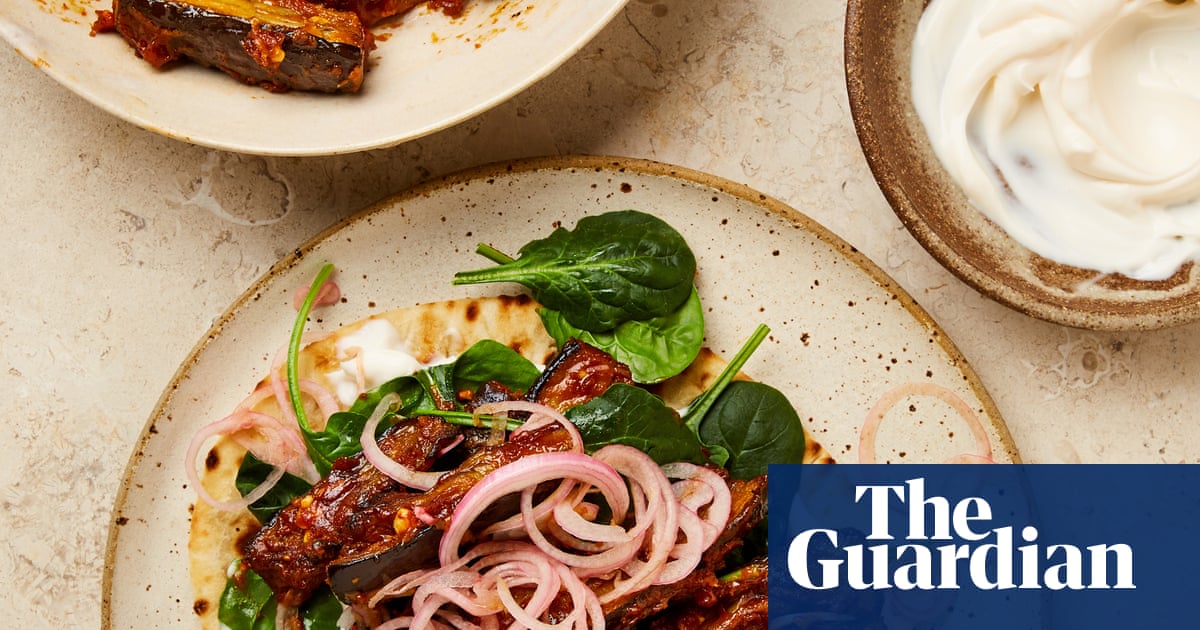
Recently, I discovered a new Greek flatbread in my local supermarket. Stout but soft, and as plump as a baby’s cheek, it set my heart a-flutter, and now that Greek flatbread and I, we’re in the throes of an early romance. I have tried to honour my flatbread with nothing but the best fillings – namely, something unscrupulously delicious (and also easy). Which is another way of saying that I’ve experimented with a lot of bung-it-in-the-oven fillings, and these sticky, peanutty and spiced aubergines came out tops.

Sticky peanut aubergine flatbreads

Prep 5 min
Cook 1 hr
Serves 4

For the aubergines
3 aubergines (1kg)
3 tbsp rapeseed oil
Fine sea salt
2 banana shallots
(150g), peeled and sliced into thin half-moons
4 tbsp red-wine vinegar
100g (or 6 tbsp) crunchy peanut butter
4 tbsp light soy sauce
3 tbsp dark agave syrup
1½ tbsp tomato paste
1½ tsp ground cumin
1 tsp cayenne pepper

To serve
Greek flatbreads – I like Deli Kitchen
80g vegan mayonnaise
100g baby spinach

Heat the oven to 200C (180C fan)/390F/gas 6. Cut the aubergines in half lengthways, then cut them into roughly 3cm x 8cm wedges. Put the aubergine pieces in a large bowl and toss with all the oil and a teaspoon of salt. Arrange on a lined baking tray, keeping the bowl to one side, and roast for 30 minutes.

While the aubergines are roasting, put the sliced shallots in a small bowl with the vinegar and a quarter-teaspoon of salt, stir to combine, then submerge the shallots in the liquid and set to one side.

Put the peanut butter, soy sauce, agave syrup, tomato paste, cumin and cayenne pepper in the empty, oily aubergine bowl, and stir to mix.

When the aubergines are ready, take them out of the oven and tip into the large bowl with the peanut butter mix. Mix well, so the aubergines are coated in the sauce, then tip the lot back on to the baking tray and spread out in a single layer. Return to the oven for another 10 minutes, until the sauce thickens and becomes sticky.

Heat up your flatbreads – just pop them in the oven for a couple of minutes. To build the wraps, spoon a tablespoon and a half of mayo into the middle of each flatbread, top with a handful of spinach leaves, and top that with some of the aubergine mix and a few quick-pickled shallots. Fold the edges around and chomp.

Adblock test (Why?)


from "recipes" - Google News https://ift.tt/uP6I8LV
via IFTTT

How to Make a Bitter Giuseppe, the Rule-Breaking Cocktail That Favors Flavor Over Booze - Robb Report

The Bitter Giuseppe is a strange and wonderful drink. The components feel like they’re put in backwards and upside down, and looking at the recipe, you’d think they were chosen at random. It is not just a new drink but a new category of drink, an undiscovered landmass in what felt like well-mapped territory; the Bitter Giuseppe is what a bartender might think up if, after asking an indecisive guest if they’d prefer something shaken and refreshing, or stirred and spirituous, the guest replied, “both, but also neither.”

“Sometimes a cocktail tells you what to do, rather than you telling it what to do,” recounts Stephen Cole in The Bartender’s Manifesto, the 2022 book about Chicago’s celebrated speakeasy, the Violet Hour. In or around 2007, an Italian chef had come into the Violet Hour and asked Cole for a drink. In a flash of inspiration he can’t explain, he decided to use as a base of the drink not whiskey or gin or brandy but Cynar, a robustly bitter, low alcohol Italian liqueur. This in and of itself, at the time, was fairly insane. To this he added an ounce of sweet vermouth, making a kind of bitter, low-ABV Manhattan. 

It was delicious, but it was too sweet. The standard corrective would be to add whiskey, but that would just make it more conventionally Manhattan-like, so he took a risk and added a very small amount of lemon juice. Then a little more, then a little more. “I just kept tasting and trying to correct my fuckups to the point where it would take a full quarter ounce of lemon and an aggressive six dashes of orange bitters for it all to come together,” he says.

Before this, no one would ever add lemon to a drink like this. Lemon juice was for sour-style drinks, like the Whiskey Smash or Tom Collins. Stirred, all booze cocktails pretty much never had lemon juice in them; it was practically a law. But Cole had recently been enjoying the sole exception to this—the lovely ‘Ti Punch, from Martinique, essentially a rum Old Fashioned with a squeeze of lime instead of bitters—and wondered if that could work here. “I was blindly moving around trying to make it work,” he writes, “and ended up just knocking it out of the park.”

Out of the park indeed. The Bitter Giuseppe is the father of pretty much all Cynar-based cocktails in general (and the Growing Old… specifically), and though it was invented just 15 years ago and doesn’t show up in many books, every cocktail bartender I know can make one from memory. As a low-alcohol drink and/or aperitivo it’s absolutely phenomenal, perfect for before a meal, for “Damp January,” or any other time you want to stay light on booze but heavy on flavor. The Cynar is deeply resonant with caramel and vegetal hum, while the vermouth offers bright and fruity top notes, the lemon juice keeps the experiment surprisingly light and fleet of foot, and the salt (see note, below recipe) reduces the bitterness and makes the whole thing pop. That the recipe reads like the product of a dare is immaterial. Try one out and see.

Bitter Giuseppe

  • 2 oz. Cynar
  • 1 oz. sweet vermouth
  • 0.25 oz. lemon juice
  • 6 dashes of orange bitters (optional)
  • Pinch of salt (optional)

Stir all ingredients on ice and pour over fresh ice into a rocks glass. Garnish with a lemon peel.

NOTES ON INGREDIENTS

ReserveBar

Cynar: Cynar (pronounced “chee-nar”) is a 16.5 percent alcohol bitter liqueur from Italy. This drink needs it or something just like it, and you can’t just grab a different amaro and hope it’ll work. Note that Cynar also makes a “70,” a version that’s 35 percent alcohol, which is not what we want here. We want the standard, red bottle. 

The only other thing to say about this is that Cynar is the biggest and most famous of what some people call the “carciofi,” which is to say, Amaros (Italian-style bitter liqueurs) flavored with, among other things, artichokes. N.B. that Cynar does not taste like artichokes—there is a vegetal quality to be sure, but mostly the experience is a caramely roundness, citrus, and robust earthy bitterness. Also, in all my years of running cocktail bars, I’ve only been exposed to a single other example of a carciofo amaro and, suffice to say, it didn’t make a better Bitter Giuseppe. Feel free to try with others if you find them, but know this drink was created for Cynar.

Sweet Vermouth: Cole originally made this for Carpano Antica, a robust and powerful sweet vermouth. This is a great choice and makes a delicious Bitter Giuseppe, very round, with the vermouth’s distinct vanilla presence playing a large role. This is also great with the leaner end of the spectrum, something like Dolin Rouge, with which the Bitter Giuseppe is a lot lighter and brighter, more aperitivo-like, better for before a meal. Still others make it with Punt e Mes, a deep chocolaty vermouth that has a significant amount of bitterness itself, which makes a fuller, more convincingly cocktail-like finished product. These are all equally delicious to me, as would be others. Choose the intensity that works for you.

Orange Bitters: From The Bartender’s Manifesto: “6 dashes is a lot, but the large amount of bitters will add both proof and complexity, which is much needed in this situation.” It’s not like I don’t see what he’s getting at—orange bitters in that quantity add a stong zesty, almost juicy orange presence, amplifying the vermouth’s top notes and balancing the low hum of the Cynar. That said, for my palate, I don’t prefer them. I think it’s good without. Feel free to find your own way.

Salt: First, the why: Salt, as it turns out, mitigates bitterness even more than sugar does, and in this case allows the tertiary flavors of Cynar to shine out from where they would ordinarily be bludgeoned by bitterness. Salt makes the drink pop.

As for the how: Cole’s original doesn’t have salt, and salt is omitted from most official recipes. That said, most of the bartenders I know (including me) had it in our heads that salt was called for. A bit of digging finds that Kirk Estopinal (of New Orleans’ Cure, Beta Cocktails, and etc) made a riff on the Bitter Giuseppe he called the Search for Delicious, roughly the same drink but with Punt e Mes instead of Carpano Antica, a bunch of lemon peels and a dash of salt, and the recipes just kind of melded in people’s brains. That puts the above recipe I suppose halfway between the Search for Delicious and the Bitter Giuseppe, but in either case, I think salt adds to it well. I recommend a pinch.

Adblock test (Why?)


from "recipes" - Google News https://ift.tt/oZWINev
via IFTTT

'Dump and Go' Slow Cooker Recipes for Your Easiest-Ever Weeknight Suppers - Yahoo Life

It’s no secret we’re big fans of the slow cooker — anything that makes getting dinner on the table easier is a huge win in our books. And fo...