Parmigiano Reggiano can make a great addition to all dishes – including desserts. 'The Only Parmesan' shares some incredible recipes that use this wonderful cheese. Here we try a couple of desserts, and we think you might want to do the same…
Crème brûlée with apricot, raspberries & Parmigiano Reggiano
Ingredients
200ml fresh cream
50ml milk
2 egg yolks
30g 24-month Parmigiano-Reggiano
4 apricots
½ vanilla pod
20g brown sugar
100g raspberries
1 bunch, food grade lavender flowers
Method
Bring the cream and milk to the boil with the seeds from the vanilla pod and whip the egg yolks in a bowl until frothy. Pour the hot milk on the eggs in a trickle, add Parmigiano Reggiano and mix.
Put half an apricot, some raspberries and some lavender flowers in each mould. Pour the cheese mixture into the moulds and cook in a bain-marie (starting from hot water) in a preheated oven at 120C for about an hour until the cream is firm around the edges and wobbly in the centre.
Take out of the oven and allow to cool down at room temperature, then put the moulds in the refrigerator for at least two hours.
Dust the surface of the crème brûlée with brown sugar and melt it using a torch before serving.
Pancakes with Parmigiano Reggiano cream, balsamic vinegar syrup and red berries
All rounder: pep up your pancakes with the addition of Parmigiano Reggiano
Ingredients
2 eggs
700 ml milk
250g Parmigiano Reggiano
200g 00 type flour – a finely ground Italian flour
200g dried red berries
200ml balsamic vinegar
200ml water
150g sugar
75g butter
50g salt
2 teaspoons baking powder
Method
Melt 25g butter on very low heat, then let it cool down slightly. Divide egg yolks from whites. Pour yolks in a bowl and whisk, then add melted butter and 200ml milk in a trickle, continuing to whisk until clear-coloured and fluffy. Add baking powder to the flour, then pour this into the bowl with the egg yolks and mix. Whisk the egg whites with a pinch of salt and sugar until nice and foamy, then fold them into the egg mixture. Put a non-stick pan on the heat. Pour a ladleful of mixture in the centre of the pan. When bubbles start forming on the surface and the base is golden, flip the pancake over and allow the other side to brown lightly.
For the Parmigiano Reggiano cream, heat up the milk without boiling and melt 50g butter in a pot. Pour 500ml of hot milk into the butter, stirring to prevent any lumps. Remove from heat and add grated Parmigiano Reggiano, stirring quickly to allow it to melt.
For the syrup, melt the sugar in the hot water and continue cooking until the mixture becomes syrupy, then remove from the heat and add the balsamic vinegar, stirring energetically.
Arrange pancakes one on top of the other with the Parmigiano Reggiano cream on the side. Pour syrup over and garnish with red berries softened in warm water.
Mahalo for supporting Honolulu Star-Advertiser. Enjoy this free story!
Nearly a dozen recipes using locally grown ingredients are in the process of getting approved by the U.S. Department of Agriculture, and they could make their way to lunch menus in public schools in Hawaii and around the country.
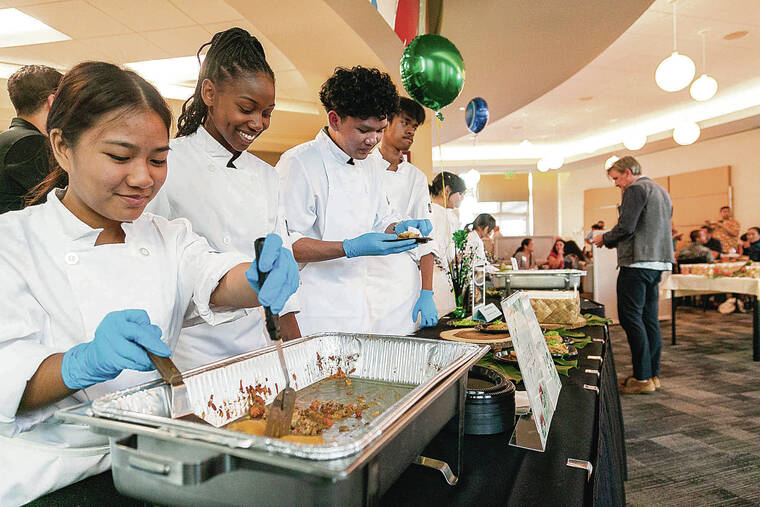
At a Wednesday event at the First Hawaiian Bank’s downtown Honolulu branch, students from local high schools unveiled 11 recipes to guests that used four ingredients readily available from local farmers: kabocha squash, sweet potato, Asian cabbage and ground beef.
The recipes, prepared and taste-tested by students, are part of a project spearheaded by the Hawaii Child Nutrition Programs to develop local recipes that, once approved by the USDA, can be used in public schools around the country.
“What you see is the culmination of two years of work with all the partners that worked with us to try to promote local products and support local farmers and sustainability in the state,” said Sharlene Wong, program administrator for the HCNP, at the event.
The unveiled recipes included enchilada casserole, kabocha tofu Thai curry, Okinawan sweet potato country bread and curried kabocha and chicken stew.
The recipes, though created with Hawaii students in mind, could be used in other U.S. public schools once they become available in a USDA national recipe database.
“My big vision is that, after we submit these recipes to the USDA, we will have school districts across the country contacting our vendors here in Hawaii and asking us to ship (ingredients) … so they can make these recipes in their school districts,” Wong said.
The HCNP, a part of the state Department of Education, has worked with students from the Kapiolani Community College Culinary Arts Program, school cafeteria managers and others to develop the recipes as part of the USDA Team Nutrition initiative.
As part of the initiative, the USDA awarded $5.5 million to 21 states, including Hawaii, for fiscal year 2021 to develop the recipes and encourage schools to offer meals that use local agriculture and reflect local food practices and tastes.
The 11 recipes were among hundreds that were initially submitted by local families, farmers and school cafeteria staff. Last year, former Hawaii First Lady Dawn Amano-Ige picked the best recipes to be standardized by the USDA.
The development of potential school meals that utilize locally grown ingredients can be an important step in the right direction for the DOE’s Farm to School program, which includes a state-mandated goal for the department to procure 30% of the food served in public schools by 2030.
The Farm to School program would connect the DOE, sometimes referred to as the state’s biggest restaurant, to small local farms, bolstering Hawaii agriculture and allowing the state to become less dependent on imported food.
Hawaii currently imports about 90% of its food from out of state, which Lt. Gov. Sylvia Luke at the event said “is not good enough for us or our future generations. We need to make sure, in order to be self- sustainable, we need to grow what we eat, and we need to eat what we grow.”
Whether the local recipes like those unveiled on Wednesday will actually make it to Hawaii public school menus is still dependent on other logistical factors, said Randall Tanaka, assistant superintendent for DOE’s Office of Facilities and Operations and lead for the Farm to School program.
The DOE’s Farm to School program, which was established in 2021, has been off to a sluggish start. One reason, Tanaka said at the event, is because high demand from the schools outweighs what small local farmers can produce.
A new Ethiopian restaurant called Erta Ale is opening soon in Lowertown in the former home of sushi restaurant Kyatchi and, previously, longtime Japanese noodle shop Tanpopo.
The restaurant is named after the Erta Ale volcano, one of the most active in Africa. Owner Amy Abebe Tsegaye picked the name to “symbolize the fiery and flavorful nature of Ethiopian cuisine,” she said in a news release.
Tsegaye, who’s from Ethiopia, is basing the menu around recipes she learned from her mother and grandmother. Along with classic Ethiopian stewed meats and vegetables served on spongy injera bread, Erta Ale will offer a weekend buffet to coincide with the nearby St. Paul Farmers’ Market. Injera, a tangy flatbread with a bouncy texture, is used as the primary eating utensil in many Ethiopian dishes; it’s typically made with a grain called teff, which is naturally gluten-free.
They’ll also perform traditional coffee ceremonies, an important cultural custom.
Erta Ale is set to soft-open the last weekend of April, and Tsegaye hopes to schedule a grand opening around Mother’s Day.
A New York Rabbi recently went viral for delivering a sermon written by ChatGPT to his congregation, causing many to question the humanity in such an act. Kurt "The CyberGuy" Knutsson reports.
The emergence of generative AI is opening a whole new world of life hacks.
A hack recently went viral on TikTok after user Mellyssa Viele posted a video about how she used ChatGPT to create a diet-specific, seven-day meal plan.
Viele prompted the chatbot to come up with a plan that is endometriosis-friendly, good for hormone imbalances in women and helps reduce inflammation.
ChatGPT was quick to fill Viele’s request, whittling down the meal plan each time she asked for something new, such as keeping each day under 1,700 calories and incorporating snacks.
"It just keeps getting better and better," she said in the video. "This thing is so smart."
Viele explained that she continued to feed ChatGPT input on what she liked, including removing tuna from the mix, until she was satisfied with meals for all seven days.
ChatGPT even took into consideration how some dinners could be eaten as leftovers for lunch the next day.
Viele then asked ChatGPT to create a grocery list according to the specific meal plan it had created.
"It gives me a grocery list … of every single ingredient, everything that I need," she said.
"And it categorizes by produce, pantry, meats."
Viele’s TikTok video currently has nearly 3 million views. She told Fox News Digital that, as a person who works in tech, ChatGPT immediately intrigued her.
"I probably have asked ChatGPT 200 questions before landing on the idea of using it for meal plans and workout plans," she wrote in a text message.
As an endometriosis sufferer of nearly 10 years, Viele said she’d done months’ worth of research to nail down a diet that would help reduce inflammation, pain and bloating.
Viele asked ChatGPT to create a seven-day meal plan for her that is endometriosis-friendly, good for hormone imbalances in women and helpful in reducing inflammation.(iStock)
"I had a rough idea of what foods are good [for endometriosis] and which to avoid," she said.
"But putting it all together in a cohesive schedule/plan was a bit tedious, so ChatGPT impressed me there."
Viele encouraged others to try out ChatGPT for meal planning and recipe building.
"Like everything, use self-discretion and your own judgment," she added. "It should be used as a helpful tool, not as the whole truth."
The ChatGPT logo on a laptop computer arranged in the Brooklyn borough of New York, US, on Thursday, March 9, 2023.(Gabby Jones/Bloomberg via Getty Images)
Tech expert Mike Pell, director of The Microsoft Garage, reacted to the life hack in an email sent to Fox News Digital.
He considered it a "great example of how ChatGPT is becoming a valuable tool for everyday things."
He also said, "Seeing the wonder at how well it did and the excitement of [Viele's] realizing what’s now possible is priceless."
Pell emphasized Viele's realization of the "level of detail and clever choices" spawned by ChatGPT to complete her request.
He added, "Systems like this will continue to learn from these early interactions and improve over time."
"While ChatGPT may be a resource for developing a healthier meal plan, I would like to see more conversation between patient, licensed nutritionist and physician to determine what is best for the patient," said one doctor.(iStock)
Nicole Saphier, M.D., a Fox News medical contributor and board-certified radiologist who also serves as director of breast imaging at Memorial Sloan Kettering Cancer Center-Monmouth in New Jersey, told Fox News Digital, "Diet, exercise and overall lifestyle are crucial when it comes to maintaining certain health ailments. I encourage anyone suffering from acute or chronic diagnoses to improve their diet to include more nutritious foods and decrease foods that may increase bodily inflammation."
"The problem I foresee with ChatGPT and other AI is that it is ultimately biased."
She added, "While ChatGPT may be a resource for developing a healthier meal plan, I would like to see more conversation between patient, licensed nutritionist and physician to determine what is best for the patient."
Dr. Saphier said further, "The problem I foresee with ChatGPT and other AI is that it is ultimately biased. Ultimately, those companies that pay for more advertisements will be incorporated into the algorithms."
She noted, "While the recipe and foods may be healthy, often there are less expensive options that will have similar effects on one’s health."
Angelica Stabile is a lifestyle writer for Fox News Digital.
It’s a time of the year when there’s a gear change in what I want to eat. The new season makes me race even more quickly towards fresh vegetables, herbs and spices, and I often find myself eating only vegetarian and vegan dishes for days on end, and without even consciously trying to. The veg doesn’t have to be freshly sun-kissed and perfectly seasonal, either – the bags of peas and spinach in the freezer are still on heavy rotation, and the dried pulses remain a staple – but the resulting dishes, when everything comes together in sunny harmony, so often remind me of (and whet my appetite for) the heat of the sun.
Potato, spinach and peas with spicy tomato oil and yoghurt (pictured top)
This dish is inspired by the enormously popular combination of potatoes and peas of the classic aloo matar, a staple of north Indian cuisine. The spicy tomato oil and yoghurt add an entirely new element that works wonderfully well. Serve with plain rice or rotis (see recipe below).
Prep 15 min
Cook 25 min
Serves 4
3 waxy potatoes (500g), peeled and cut into 2cm x 5cm wedges 2 plum tomatoes (180g) 90mlvegetable oil
1½ tsp cumin seeds
1 medium onion, peeled and finely chopped (180g) Fine sea salt
2 garlic cloves, peeled and crushed 20gfresh ginger, peeled and finely grated ¼ tsp ground turmeric
250g fresh or defrosted frozen peas 250g defrosted frozen spinach, squeezed dry 1 tsp chilli flakes (or less if you prefer things less spicy) 1 tsp black mustard seeds
2 tsp tomato paste
75g plain yoghurt
Bring a medium saucepan of well-salted water to a boil, then add the potato wedges and cook for 12 minutes, until cooked through. Strain through a colander set over the sink, set aside to drain well and wipe out the saucepan.
Meanwhile, set a small sieve over a small bowl and, using the coarse side of a box grater, grate in the tomatoes, discarding the skins as you go, then set aside.
Return the pan to a medium-high heat, add 60ml of the oil and, once it’s hot, add the cumin, onion and a teaspoon and a quarter of salt, and cook, stirring occasionally, for five minutes, until translucent. Stir in the garlic, ginger and turmeric, cook for a minute until fragrant, then pour in the strained tomato water from the bowl. Using a spoon, release any bits stuck to the bottom of the pan, then stir in the peas and spinach, and cook for another five minutes, until all the moisture has cooked out and the vegetables are nicely coated in the oil.
Meanwhile, put the remaining two tablespoons of oil in a small frying pan on a medium heat. Once hot, add the chilli flakes and mustard seeds, and cook for a minute, until they start to pop. Add the grated tomato pulp, tomato paste and a quarter-teaspoon of salt, and cook for three minutes, until the oil separates and the tomato darkens in colour.
Stir the potatoes through the spinach and peas, and cook on a medium-high heat for a minute or so, just to heat through, then transfer to a serving platter. Spoon on the yoghurt and serve with the tomato oil drizzled over the top.
Aubergine and mung bean curry with coriander cream
Stewed mung beans appear in various forms in multiple cultures, and especially throughout Asia and the Middle East. This very aromatic and spiced version has quite a kick of chilli heat, but that’s tamed by the coriander cream. Serve as a spread with this week’s other two dishes, or just as it is with plenty of rice.
Soak 30 min+
Prep 25 min
Cook 40 min
Serves 6
For the curry 160g dried mung beans
¼ tsp bicarbonate of soda
2 medium onions (300g), peeled and thinly sliced 5 garlic cloves, peeled and thinly sliced 20g fresh ginger, peeled and finely grated 20g fresh turmeric, finely grated 2½ tsp garam masala
2 red chillies (20g), thinly sliced (remove and discard the pith and seeds if you prefer less heat) 60g coconut cream, plus 100g extra for the coriander cream
For the aubergines 9 baby aubergines, or two regular aubergines (560g), cut lengthways into quarters from the base and leaving the stems attached 4½ tbsp olive oil
Fine sea salt
For the coriander cream 30g bunch coriander, 1 tbsp leaves picked and reserved 2 limes, juiced, to get 2½ tbsp
First, soak the mung beans. Put the dried beans in a colander, wash in lots of cold water, then tip into a bowl and add the bicarb. Add just-boiled water to cover, then leave to soak for at least 30 minutes to an hour, or overnight, until the beans have slightly softened.
Heat the oven to 240C (220C fan)/475F/gas 9. Put the aubergines and a tablespoon and a half of olive oil in a bowl with half a teaspoon of salt, toss to coat, then put skin side down on a large oven tray lined with baking paper. Roast for 20-25 minutes, until the aubergines have softened but are still holding their shape.
Meanwhile, put the remaining three tablespoons of olive oil in a large saute pan for which you have a lid and set it over a medium-high heat. Add the onions, garlic, ginger, turmeric, garam masala and chillies, and cook, stirring frequently, for 10 minutes.
Drain the mung beans, then add to the pan with 800ml fresh cold water and three-quarters of a teaspoon of salt. Stir to combine, bring up to a simmer, then turn down the heat to medium, cover and cook for 15 minutes, until tender.
Stir in 60g of the coconut cream, then add the aubergines, cover again and cook for another 10 minutes, until the aubergines are soft and the cooking liquid has thickened. Take off the heat and set aside, still covered, to rest for five minutes.
Meanwhile, make the coriander cream. Put the remaining 100g coconut cream in a food processor with the coriander, lime juice and a quarter-teaspoon of salt, blitz smooth, then scrape out into a bowl.
Spoon half the coriander cream all over the curry, scatter over the reserved coriander leaves and serve with the remaining coriander cream on the side.
Herby ghee rotis with preserved lemon pickle
I have a real fondness for lemon pickles, and this one, which makes use of preserved lemons as a welcome shortcut, is no exception. These rotis freeze very well, so if you can’t make use of them all, freeze the leftovers individually between sheets of greaseproof paper and wrapped in reusable kitchen wrap for up to a month. To make the rotis vegan, swap the ghee for olive oil.
Prep 15 min
Cook 30 min
Makes 8
160g wholewheat flour
160g plain flour, plus extra for dusting 30gparsley leaves, finely chopped 2 spring onions, trimmed and finely chopped (30g) 30g ghee, melted (or olive oil), plus 50g extra for brushing Fine sea salt, plus flaked sea salt, to finish
For the preserved lemon pickle 90ml sunflower oil
2½ tsp black mustard seeds
½ tsp fenugreek seeds
½ tsp sweet smoked paprika
4 tsp aleppo chilli flakes
200g preserved lemons, hard pith and seeds discarded, skin and flesh chopped into ½cm pieces ¼ tsp caster sugar
First make the dough. Put the two flours, two thirds each of the parsley and spring onions, 200ml cold water, the ghee and a teaspoon and a quarter of salt in a large bowl. Mix well to combine, then knead by hand for about five minutes (or in a stand mixer with the dough hook for about three minutes). You should end up with a slightly sticky dough, but do not be tempted to add more flour. Cover with a tea towel and set aside to rest for 20 minutes.
Meanwhile, make the lemon pickle. Put the oil in a small saucepan on a medium heat and, once it’s hot, add the mustard and fenugreek seeds, and cook for 30 seconds, until fragrant. Stir in the paprika and aleppo chilli, then add the chopped preserved lemon and sugar, cook gently for three minutes, then take off the heat and leave to cool.
To make the rotis, lightly flour a work surface, then knead the dough into a smooth ball. Divide this into eight equal 70-75g pieces, roll each one into a ball, then cover with a clean tea towel.
Now prepare your roti cooking station. Put a medium frying pan on a medium-high heat for five minutes. Put the remaining 50g melted ghee and the remaining parsley and spring onions in a bowl and stir to combine – I use a pastry brush to do this. Put a clean tea towel on a plate. You are now ready to roll.
Sprinkle a little flour on the work surface and, using a rolling pin, roll one of the balls into an 18cm-wide disc (don’t worry if it’s not perfectly round). Shake off any excess flour, if need be, then lay the disc in the hot pan and leave to cook for a minute to 90 seconds, until the top of the roti is just starting to bubble. Brush the top with the herby ghee mixture, then flip over the roti and brush the other side with ghee. Cook for another minute, until small golden patches start to appear on the base, then take off the heat and transfer to the tea towel-lined plate. Sprinkle a little flaked salt on the cooked roti, fold the tea towel over the top to keep the roti warm, and repeat with the remaining dough balls and herby ghee.
Serve the rotis warm with the bowl of pickle in a bowl on the side.
Cream cheese is perhaps one of the most versatile cheeses you can buy. From casseroles to desserts to side dishes, it's used in a wide variety of recipes. While cream cheese is a very versatile ingredient, appetizers are perhaps one of our favorite ways to make use of the refrigerator staple.
While we'll always love pouring a jar of pepper jelly over cream cheese for an instant appetizer, we've rounded up a list of other easy and delicious appetizer recipes you can whip up with the block of cream cheese in your fridge.
Antonis Achilleos; Food Styling: Emily Nabors Hall; Prop Styling: Kay E. Clarke
The classic appetizer of cream cheese and pepper jelly gets an upgrade with the addition of jumbo shrimp and seasoned crackers.
Hector M. Sanchez Styling: Caroline M. Cunningham
A filling made with cream cheese and chicken offers a nice contrast to the spicy jalapeno chiles.
This recipe turns the flavors of the classic sandwich into a crowd-pleasing dip.
Caitlin Bensel; Food Styling: Torie Cox
No party is complete without a cheese ball. Just make sure your cream cheese is softened before you begin making it.
Photographer: Antonis Achilleos, Prop Stylist:Christine Keely Food Stylist: Chelsea Zimmer
This cheesy dip comes together in just 10 minutes and doesn't require any cooking.
Antonis Achilleos; Prop Styling: Kay E. Clarke; Food Styling: Emily Nabors Hall
We swapped the traditional pepper base for okra in this stuffed poppers recipe.
Victor Protasio; Food Stylist: Chelsea Zimmer; Prop Stylist: Christine Keely
This recipe gives sausage balls a creamy upgrade thanks to the addition of a block of cream cheese.
Photographer: Jennifer Causey Food Stylist: Melissa Gray Prop Stylist: Kay Clarke
In addition to a block of cream cheese, this ultra-cheesy dip also calls for 6 ounces of sharp Cheddar cheese and 6 ounces of Pepper Jack cheese.
This slow-cooker dip couldn't be easier. Simply dump all of the ingredients into the crock and you'll have a warm, cheesy appetizer in about 2 hours.
Frozen pretzel bites help this dish come together easily.
Victor Protasio; Food Stylist: Chelsea Zimmer; Prop Stylist: Christine Keely
As shown, crisp vegetables are great for scooping up this cheesy dip but pita chips are a good option as well.
Victor Protasio; Food Stylist: Chelsea Zimmer; Prop Stylist: Christine Keely
Deli ham and pecans add an extra layer of heartiness to this classic cheese ball.
Hector Manuel Sanchez
Make sure to reserve the scallions to add once the dip is finished cooking.
James Ransom, Prop Stylist: Christine Keely, Food Stylist: Ruth Blackburn
Serve these miniature cheese balls with extra crackers in addition to the cracker that's placed on top of each one.
Antonis Achilleos; Prop Styling: Kay E. Clarke; Food Styling: Emily Nabors Hall
Think of this baked dip as a slightly elevated version of cream cheese and pepper jelly. The goat cheese mixture can be made ahead and stored in the refrigerator.
Victor Protasio; Food Styling: Ruth Blackburn; Prop Styling: Christine Keely
Chorizo sausage adds some extra spice to this stuffed chile appetizer.
Antonis Achilleos; Prop Stylist:Christine Keely; Food Stylist: Chelsea Zimmer
This Kentucky staple is a refreshing spread that's made with cream cheese and cucumbers.
Hector Manuel Sanchez
In addition to cream cheese, this cheese ball recipe also calls for feta cheese as well.
Max Miller is a proud, self-described history enthusiast, even though he’s quick to admit that he’s not a professional historian with extensive academic credentials. Instead, he’s more of a freelance nerd, who spends his time reading pretty much anything he can get his hands on about historic recipes. “I don’t have formal training,” he says. “It’s just a passion, I love history. I took a lot of history classes in college and I’ve been devouring history books and documentaries since I was a little kid.”
In February 2020, just before the COVID-19 pandemic forced us all to stay inside and spend too much time staring at our screens, Miller launched a YouTube channel called Tasting History, a place where he recreated recipes from various historic eras. The channel was a sleeper hit, and now boasts 1.7 million subscribers who tune in to watch Miller make medieval-style French toast and a tiger nut cake recipe prepared in ancient Egypt.
The success of his channel led to a new cookbook, Tasting History: Explore the Past Through 4,000 Years of Recipes, released earlier this week. Eater sat down to talk with Miller about this collection of ancient recipes, whether or not he expects anyone to actually try to make most of them, and what modern cooking conveniences he loves most.
Eater: Your new book,Tasting History, is extensively researched. One thing I noticed is that the recipes come from different types of documents and records. In what types of books or records did you find the best recipes?
Max Miller: Actual cookbooks, obviously, are definitely the easiest. But the further we go back in time, the less available those are. One thing I rely on a lot is newspapers; they’ve included recipes since their advent in the 17th century. Before then, I tend to look to things like poetry, or for writings from someone who’s describing a different culture than their own. Throughout history, it’s somewhat rare for people to write about their own food. In Europe and in China, people wrote recipes down, but a lot of cultures passed that information orally. Or it was just culturally understood; there was no need to write down how to make rice because everyone just knew what that dish was.
When someone goes to a new place, though, they write that information down, because it’s new to them. Especially in the early medieval period, the 10th, 11th, and 12th century, there were travelers, largely from the Arabic world, writing about the foods they came in contact with through their involvement with the spice trade. You can find wonderful descriptions of food in those writings; I can build a recipe from those. But you have to be careful, because this person is an outsider, and who knows if they’re faithfully writing down what they’re seeing? Sometimes, you just can’t tell.
Your YouTube channel, Tasting History, has tons of subscribers. Were you surprised to find out that so many people were interested in the intersection of history and food?
It shocked me. The reception was great pretty much right off the bat, even within the first couple of months. I expected it to be a very niche audience. What surprised me the most, pleasantly, was the reception to the history portion. I thought I would talk to people about food and covertly make them learn some history at the same time, but it’s the history part that my viewers seem to enjoy the most.
Because you approach the subject from a lay background, have you had any run-ins with historians over the disputed historical origins of some specific food?
Usually, I’m getting kudos from professionals. There aren’t a lot of food historians out there, which means that it’s a pretty small world. Ken Albala, one of the most prominent food historians, is a huge supporter of the channel and of the book. I try to make it very clear to people that there’s a difference between what I do and what a real historian does. I have a lot more freedom. A real historian’s job is to take their feelings out of what they’re interpreting, and take this 10,000-foot view. I don’t make an attempt to do that at all. I love relying on first-person accounts, and first-person accounts almost never make for good academic history because everyone puts their own individual spin on things. But they do make for very, very good storytelling.
It can, however, be easy to fall into these little traps laid by previous historians, and that’s true in any discipline. In the 19th century, it was not uncommon for Victorian scientists to simply make details up in order to make a story work. If they had a set of facts that they couldn’t connect, they would just make up a story to connect them. That wasn’t frowned upon then, which means that it can sometimes be hard to separate truth from fact, especially when that story has been repeated by lots of reputable sources.
What are the common threads that you see across different time periods? What specific dishes or preparation methods show up over and over again?
Every single culture has bread, and it’s so important to every culture that even when it goes bad, people still figure out a way to use it. The mixing of sweet and savory foods is also something you see throughout the years and all over the world. People would add honey, or sugar, or date syrup to a dish that we would normally think of as a dinner entree. Sometimes I’ll do a video where I’m mixing sugar and spices together and putting it on meat, and I get so many comments that are like “this is just weird.” But then I remind them about barbecue. Do you eat barbecue? Because that’s what barbecue is. And speaking of barbecue, that’s a very medieval dish in itself, and a technique you find all over the world.
Do you viewTasting Historyas a history text or a practical cookbook? Do you think people will actually make everlasting syllabub, a cream-wine concoction, or saffron-hued Sally Lunn buns?
I hope people do make them! Some of the dishes, if you make them, you’ll make them once, but others can become a staple. Everlasting syllabub is basically just sweet, boozy whipped cream. It’s delicious, and it’s super easy. But then there are those, like blood soup from ancient Sparta, that I imagine most people probably won’t try to tackle, even if they’re interested in the dish and its origins. Maybe that’s part of the fun, sussing out which recipes you should actually make now and which can stay in history.
Are there any modern ingredients that you’ve become especially grateful for after making so many recipes without modern ingredients?
We complain about refined white flour, because a lot of people think it isn’t particularly healthy, and it isn’t as flavorful as some other flours. But it’s so easy to work with, it’s so reliable. I truly appreciate modern flour: Ancient flours can be so hard to work with, and your end result isn’t this light, fluffy bread. And just the grocery store in general: Throughout history, and in many parts of the world today, people devote so much time to getting and preparing food. Thanks to the supermarket, it’s so easy. Being able to go to the grocery store or out to eat at a restaurant is something that I think we should be a little more grateful for.
Are any of these historic recipes now mainstays in your own regular cooking rotation?
Everlasting syllabub is definitely one of them. I really do love it. The hummus kassa, which is a 14th century Egyptian recipe for hummus, has tons of different spices and nuts and oils, and it’s much more complex than a modern hummus. It’s fantastic. And even if I’m making a more simple hummus, I can add some of those ingredients to give it the kassa flair. You don’t necessarily have to make these recipes, but it’s fun to think about how they influence how we make food today. Some things shouldn’t be forgotten.
This interview has been edited and condensed for clarity.